
In this article
Need a little support with this?
Rachel’s work is shame-free, direct, and grounded in therapy-informed tools for sex, relationships, and mental health.
Shame-free note: Use this article as a starting point, not a scorecard. Take what helps, leave what does not, and come back to the parts that deserve more care.
If touch or pleasure have ever felt complicated, inconsistent, or even unavailable, especially after stress, trauma, parenting, illness, or disconnection, you’re not alone. Introducing the pleasure ladder.
Many people think of pleasure as a binary experience: either you want it or you don’t. But pleasure isn’t a switch; it’s a relationship, and one that shifts over time and deserves space to be rebuilt with care.
Enter the pleasure ladder, a trauma-informed, somatic approach to reconnecting with sensation, safety, and desire.
What Is the Pleasure Ladder?
The pleasure ladder is a framework rooted in somatic sex education and trauma-responsive bodywork. It draws on the Institute for the Study of Somatic Sex Education and practices inspired by Dr. Betty Martin’s Wheel of Consent, which emphasizes mutual agreement, internal yes/no awareness, and reclaiming agency in touch.
The core principle is this: touch is a spectrum, not a destination.
Wherever you are – shut down, overwhelmed, uncertain, ambivalent – the ladder offers a step-by-step structure for tuning into your body, honoring what’s true, and slowly expanding into what feels good.
This approach is especially useful for people navigating the aftermath of trauma, body disconnection, or chronic stress. It allows for movement at your own pace, with no expectation to “get somewhere.” Each rung is complete on its own.
The Four Steps of the Pleasure Ladder
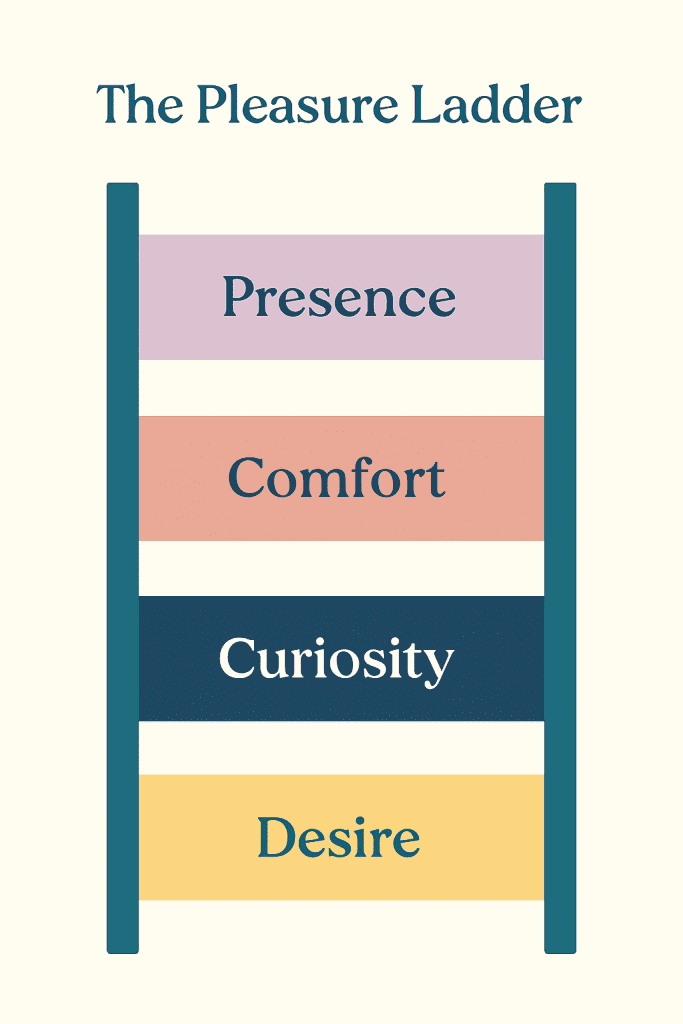
Presence
Begin with noticing. What’s happening in your body right now? Can you feel your feet on the floor, your clothes on your skin, your breath in your chest? These tiny signals help anchor you in the present moment.
According to trauma researcher Dr. Bessel van der Kolk, reestablishing a sense of embodied presence is a cornerstone of post-traumatic healing (The Body Keeps the Score, 2014). Before we even think about pleasure, we need to rebuild the ability to be with ourselves.
Comfort
Ask yourself what feels safe, neutral, or tolerable. This might be a soft blanket, warm water, placing a hand over your heart, or a pressure that feels grounding.
This stage is often overlooked, but essential. Comfort becomes the scaffolding for trust. In clinical settings, clients with chronic stress or touch aversion often benefit most from starting here, rather than skipping to what’s “supposed” to be pleasurable.
Curiosity
From comfort, we move gently into curiosity. What textures, movements, or rhythms feel interesting? What draws your attention, not because it’s sexual, but because it feels good enough to notice?
In “Walking the Tiger,” somatic practitioner Peter Levine emphasizes that curiosity is a doorway to reestablishing agency in the body after experiencing trauma. This rung is where experimentation begins, without the pressure to perform.
Desire
Only after presence, comfort, and curiosity do we invite desire into the conversation.
In Come As You Are, Dr. Emily Nagoski explains that many people (especially those socialized as women) experience what’s called responsive desire, which is a form of arousal that emerges only after safety, connection, or physical engagement. Rather than appearing “spontaneously,” desire shows up once the nervous system has settled into a sense of trust.
If you don’t feel “in the mood” until after you begin engaging, there’s nothing wrong with you; you’re probably a human being with responsive desire.
Why the Pleasure Ladder Matters
Most cultural narratives about sex and pleasure emphasize speed, escalation, and goal-oriented touch. But for people healing from trauma, coming back from postpartum disconnection, navigating neurodivergence, or simply moving through grief or stress, these expectations can feel alienating or overwhelming.
The pleasure ladder makes room for nonlinear, self-directed exploration.
It asks:
- What’s accessible right now?
- What feels like a yes, even if it’s a quiet one?
- What would it mean to let that be enough?
Applications for Therapy, Coaching, and Everyday Life
The ladder can be used personally, relationally, or clinically. For therapists, coaches, and sex educators, it offers a language to explore sensory re-engagement without pathologizing disconnection. For couples, it can soften dynamics in which one partner feels pressure or when desire differences have created distance.
This framework is beneficial for clients who say things like:
- “I want to want it, but I don’t.”
- “I can’t feel my body.”
- “I feel touched out, but also disconnected.”
It helps them locate themselves and their nervous systems within a roadmap that prioritizes safety and consent.
Try This
Choose one step on the ladder to explore this week. Not to push through it, but to notice what’s possible.
Ask yourself:
- What step am I on today?
- What kind of touch feels safe enough?
- Where does my attention go, and what happens when I follow it gently?
Final Thoughts
Pleasure doesn’t need to be urgent, performative, or look the way it used to.
You get to start again, stay curious, and redefine what intimacy and connection look like, starting with your own body.
If you want support in rebuilding your relationship to touch, whether emotionally, physically, somatically, or relationally, you can work with me or someone on my team. We’d be honored to walk that ladder with you.
If you want more writing like this, you can browse my posts on mental health , sex, education , relationships and product reviews.
Related support
If this article brought up something you want support with, these pages may be a helpful next step.
Want help applying this to your real life?
If this brought something up for you, you do not have to sort through it alone. Explore therapy, coaching, workshops, and learning options built around direct, inclusive, shame-free support.