In this article
Need a little support with this?
Rachel’s work is shame-free, direct, and grounded in therapy-informed tools for sex, relationships, and mental health.
Shame-free note: Use this article as a starting point, not a scorecard. Take what helps, leave what does not, and come back to the parts that deserve more care.
By Sara Cornwall
Howdy! How’s it going? What’s that I hear? You wanna open up? You and your spouse/partner are thinking about “opening up” your monogamous relationship?
Congratulations! What an exciting journey you are about to embark on.
My ex-husband and I were once like you – so excited, so innocent, so wildly unprepared for what we were getting ourselves into!
Yes, you heard me right. I said “ex”-husband.
Wait! Don’t run away! I’m not trying to scare you off, and I’m not being smug (well, maybe a little). I’m proudly polyamorous! I believe that non-monogamy – in its many forms – is a valid and vital relationship style. That doesn’t change the fact that opening up was ultimately a pathway to divorce for my ex-husband and me. As Rachel would say, “That’s an AND.”
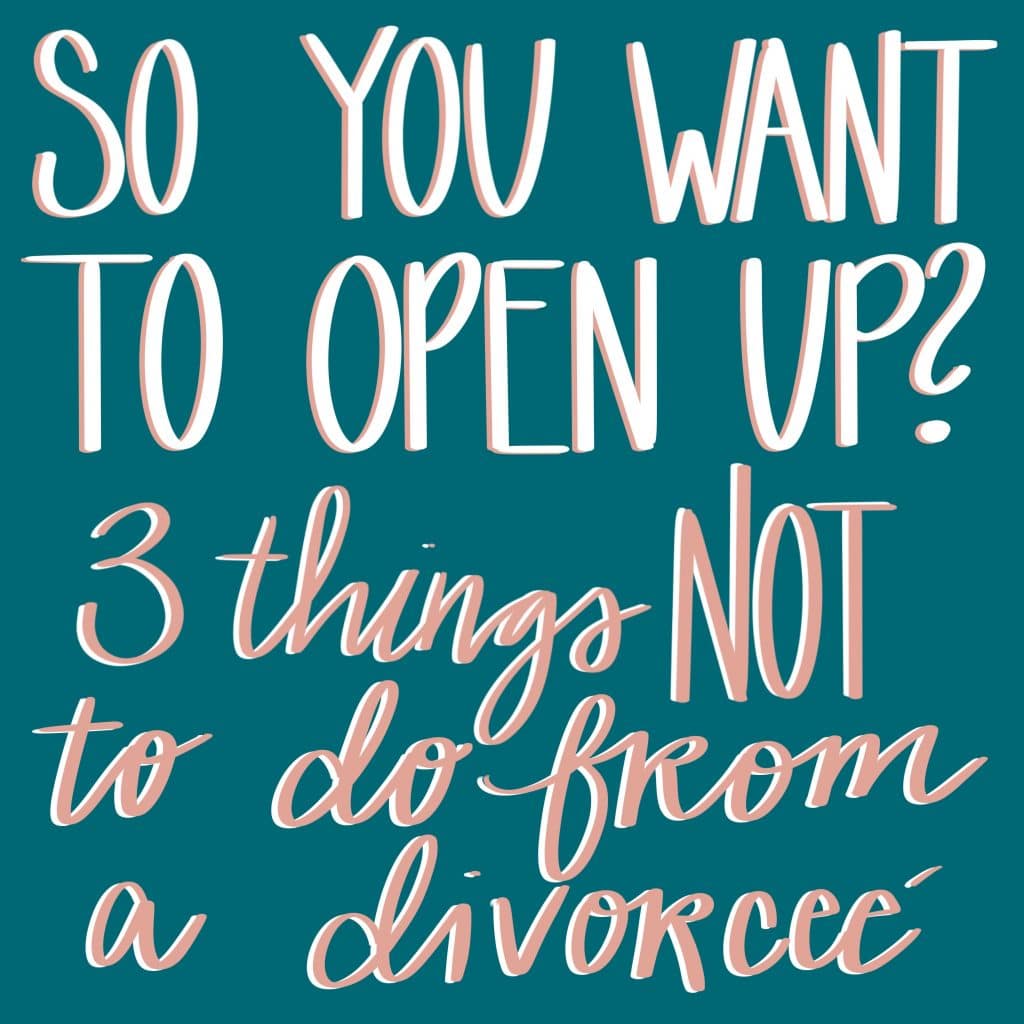
I learned a LOT from that experience, and I would LOVE to tell you what NOT to do if you are considering opening the doors to your monogamous relationship! Here are three things NOT to do when opening up your relationship.
#1 – Do NOT open up your relationship to fix it
You are probably opening up your monogamous relationship because something isn’t working.
STOP.
Don’t go any further. It’s time to reflect.
Most of us were raised in an environment where the “default” is monogamy. Monogamy is assumed to be the norm. It’s what’s expected. We’re not taught to question it. We’re often not taught that it’s even a choice. That, of course, isn’t true! Consenting adults can have as many loving, intimate relationships as they want. The practice of being open and honest about having multiple sexual and romantic partners is known as Non-Monogamy (often referred to as Ethical or Consensual Non-Monogamy).

If the ONLY thing wrong with your monogamous relationship is the fact that it’s monogamous, then opening up is probably going to be a good choice. If you are both mainly happy and fulfilled in the relationship but crave the freedom to explore other partners, it’s a good indicator that this is the right step for you. Congratulations on making it this far and on being brave enough to create a relationship based on your needs, not on what society tells you is “normal!”
If, however, you are opening up the relationship because your relationship is dysfunctional, I can promise you that adding more people into the mix is a recipe for DRAMA. AND, it’s not inherent that adding people creates drama — it’s the introduction of more people into an already dysfunctional space.
The only thing worse than not handling your stuff effectively is inviting more people into the mix and making things more complicated for everyone.
If you are seeking to date other people as a means of avoiding dealing with issues with your current partner, you are only going to exacerbate those issues. Do yourselves a favor and figure out if this relationship is worth saving BEFORE you think about opening it up. Not all relationships are meant to last forever. Do you really need to open this relationship, or do you need to end it and go out into the world seeking out ENM or polyamorous partners who share your values?
If the relationship is worth saving, do the work to build a strong foundation before you consider dating other people.
#2 – Do NOT skip the risk assessment before you open up
One of our most substantial psychological biases as human beings is overconfidence! We tend to assume we’ll be great at everything we try and that things will go well.
I’m not saying that opening up your relationship isn’t going to go well. I AM saying that it isn’t going to be easy. Opening up your relationship will add a layer of complexity to your life. It is highly likely to bring up challenging emotions, such as jealousy and insecurity.
One thing that my ex and I failed to do was a risk assessment. We never sat down and asked ourselves what might happen. What are the worst-case scenarios? What would we do if they actually happened?
Some questions that I would urge you to ask together:
- What happens if someone gets an STI?
- What happens if someone falls in love? (One of us with someone outside of our relationship, or someone outside of our relationship with one of us? What if it’s mutual? What if it isn’t? Are we hoping to fall in love with other partners? Are we trying to avoid it?)
- What happens if I get pregnant/if you get someone pregnant? (If relevant)
- What happens if someone wants to move in with us?
- What happens if one of us wants to move in with another partner?
This is by no means an exhaustive list! Please add any questions that come to mind. If you and your partner find it difficult to broach these subjects, that’s a good sign that you’ve got work to do on your communication skills before you open up.
And no, do NOT sit there and say, “No one is going to get an STI. We’ll always use condoms!”
That’s the overconfidence talking. Think back. Can you put your hand on your heart and say that you have ALWAYS had protected sex EVERY SINGLE TIME? I bet you can’t. The point of a risk assessment is to think about what you would do IF a worst-case scenario happens. Please don’t blow it off, assuming that it could never happen to you. What can go wrong, just might.
#3 – Do NOT assume your vision will align with your partner’s vision to open up

The first step in opening your relationship is to visualize what your ideal open relationship looks like. How many people are involved? What are their genders and sexual orientations? Would you all live together in a group? Would there be a hierarchy where your formerly monogamous relationship was considered primary? Do you envision dating separately? Together? Both? Are you seeking love with other partners, or just sex? Or both? As you can see, the possibilities and combinations are endless! It is a BIG mistake to think that everyone has the same end goal in mind when it comes to creating a non-monogamous relationship or lifestyle.
My ideal scenario was me having other male partners —potentially one of whom was a Dom —who I would date separately, particularly when my ex was away for work (which happened a lot).
My ex-husband’s ideal scenario looked like play-together openness, with us inviting other women into our bed and attending play parties together.
Unfortunately, I am not at all interested in playing with women. Play parties are fun, but I can take them or leave them. My ex strongly resisted the idea of me being with other men and got extremely jealous. Rather than compromising to meet each other’s needs, we started resenting each other. Some people might have been able to make it work; however, we were both so hurt and disappointed by the mismatch of our ideal visions that it became unsalvageable. Ultimately, we decided it was better to go our separate ways.
It’s all a journey of self-discovery.
I don’t regret trying to open up my marriage. Often, monogamous people assume that opening up our marriage broke us up because “that can never work.” I disagree. I am grateful for the lessons non-monogamy taught me about my values, needs, and desires. If we hadn’t tried opening up, we might both still be clinging to a marriage that wasn’t allowing us to be our authentic selves.
I am now happily solo-polyamorous.
I live alone and maintain multiple fulfilling relationships in different ways (including my beloved Dom!). Non-monogamy was a crucial pathway to self-discovery, and I am grateful for it. I hope my hard-won lessons can help you prepare for your journey into the unknown. It won’t always be easy, but it will be worth it.
If you’re interested in learning more about non-monogamy, check out Rachel’s workshops. Or fill out this form to work with one of Team RW’s coaches or clinicians.
If you want more writing like this, you can browse my posts on education, mental health, sex, and relationships.
Related support
If this article brought up something you want support with, these pages may be a helpful next step.
Want help applying this to your real life?
If this brought something up for you, you do not have to sort through it alone. Explore therapy, coaching, workshops, and learning options built around direct, inclusive, shame-free support.